
Tracking Senior Dogs: What to Watch For After Age 10
The handful of small changes in a senior dog that are worth tracking before they become problems, and why 'he's just old' is rarely the whole story.
When Ralph turned ten, our vet did something she hadn’t done at the previous checkup. She put the stethoscope away, sat on the floor next to him, and watched him walk across the exam room and back.
Not the exam. The walk.
What she wanted, on this particular visit, was to see how he moved, without me hovering, without him being distracted by me trying to comfort him, without the ten-minute conversation we’d been having about his bloodwork. She wanted the walk.
It was a two-minute observation. She did it once a year from then on. And it was, in retrospect, the most clinically useful thing any vet ever did for us.
What “senior” actually means (it depends on the dog)
Before any of this makes sense, you have to retire the idea that “senior” is a fixed age. It isn’t. It is a wide range, and it shifts with the dog in front of you.
The common shorthand is that small and medium breeds are considered senior somewhere around age 10 to 12, and large or giant breeds somewhere around age 6 to 8. A Great Dane at six is, physiologically, closer to a Labrador at eleven than a Beagle is. A working-breed dog who has run hard for ten years may have a body that looks fifteen. A toy-breed dog at thirteen may still be moving like a six-year-old. The number on the calendar is a rough hint, not a verdict.
This is also why vet clinics increasingly use a “senior wellness” tier that starts earlier for some patients and later for others. The point is to start the watching before the watching is urgently needed. If your dog is a large breed and is six, you are not early. You are on time.
So when I write “senior dog” below, I mean a dog whose body is showing the early signs of accumulated wear, not a dog of a particular age. Some of what follows is most useful for the ten-to-thirteen medium-dog window, but almost all of it scales to giant breeds earlier and to small breeds later.
Why “he’s just old” is rarely the whole story
Aging in dogs is not a single thing. It is a long, slow accumulation of small changes, each of which is easy to dismiss on its own. Maybe they sleep more. Maybe they are slower on the stairs. Maybe they don’t greet you at the door the way they used to. Maybe they skip a meal here and there, or pace at night, or look thinner across the back end than they did a year ago. Any one of those, on its own, is unremarkable.
Not because owners don’t care. They care enormously. Because owners see the dog every day, and a daily change is invisible by definition.
This is the same reason a friend didn’t notice her dog had lost a kilo and a half until the vet pointed it out. A kilo and a half is a six percent drop for a medium dog. It happens over a year. It is exactly the kind of change that, in a palliative-care conversation months later, gets remembered as “he lost weight near the end”, when the trajectory was actually visible the whole time.
The point of tracking senior dogs is not to medicalize them. It is to make a one-year change visible in week three.
The handful of things worth tracking
I am going to suggest six. Not because six is the magic number. It is the number I have arrived at after watching enough families go through this. Six is small enough to keep up on a tired evening. Six is large enough that, together, they catch most of what matters.
1. Weight
The single most useful number a senior dog owner can track. Weigh at home if you can (a bathroom scale with dog + me minus me works fine), or stop into the vet’s office every couple of months. Most clinics will weigh a walk-in for free.
What you are watching for is trend, not single readings. A medium dog’s weight should not silently drift down by ten percent over a year. That is a kidney flag, a cancer flag, a dental flag, a heart flag. A weight that drifts up on a senior dog is its own warning: cortisol, fluid retention, reduced activity.
Write the number down. The number is the language. The number is what you bring to the vet.
2. Mobility on a flat, familiar surface
Forget the dog park. Forget the stairs. The most diagnostic walk for a senior dog is across your own living room floor, twice, in a straight line, while someone else watches. What you are looking for is asymmetry: is one hind leg weaker than the other? Is the head carried lower? Is there a head-bob on the front end that wasn’t there six months ago? Does the dog sit down mid-walk rather than continuing?
None of these observations require veterinary training. They require one other person, ten seconds of attention, and the willingness to write down what you saw. AAHA’s senior-care guidelines and most veterinary rehabilitation specialists will tell you the same thing: gait changes are the earliest sign of orthopedic pain, and owners are best positioned to see them because they see the dog every day.
The point is not to diagnose a cruciate tear at home. The point is to notice that the walk looked different in May than it did in March.
3. Appetite, as a pattern, not a moment
Most senior dogs have at least a few off meals. A senior dog who eats a full bowl at every meal every day for years is, frankly, not the typical case. What you are watching for is whether the off meals cluster. Are they more frequent at night, or after a long rest, or after exertion? Does the dog eat enthusiastically when hand-fed but ignore the bowl? Does the dog want food but stop partway through?
These are different problems with different causes, and “he isn’t eating” tells the vet almost nothing while “he eats enthusiastically for the first three bites, then walks away, and has been doing this for ten days” tells the vet a great deal.
4. Sleep, quality and pattern
Senior dogs often sleep more, and that part is not usually a problem. What is worth tracking is the kind of sleep. Does the dog settle and stay settled, or pace and reposition through the night? Does the dog bark or whine at night when previously silent? Has the dog stopped sleeping in their usual spot (the bed, the rug by the door, the couch) and started sleeping somewhere unexpected?
Night-time restlessness in senior dogs has a surprisingly long differential list: cognitive dysfunction (dog dementia), pain that becomes more visible when there is nothing to distract from it, sensory changes, and anxiety. Each of these is treatable. None of them get treated if no one writes down that the pattern changed.
5. Continence and hygiene
Small accidents in a previously reliable dog are one of the most common things owners dismiss as he's just old. He is not just old. He is either drinking more (which has its own list of causes), losing tone, cognitively declining, or, most commonly, developing spinal or hip pain that makes the posture to urinate or defecate uncomfortable. All of these are worth a vet conversation, and all of them are easier to address in month three than in month nine.
This is also where hygiene on the scale we discussed in the HHHHHMM post catches the early signs. A senior dog who is still immaculate is one thing. A senior dog who is starting to need a wipe-down after walks is another, and the gap between the two is the one worth measuring.
6. The thing that is specific to your dog
This is the one I cannot give you a checklist for, because it depends on the dog.
For Ralph, it was the way he greeted me at the door. He had a particular noise, a low, throaty whine that was his version of oh good, you’re home. The noise itself told me nothing. The fact that it disappeared, for a few weeks, before slowly returning, told me a great deal about how he was feeling in ways no other measurement did. When I described it to the vet, she nodded. That was useful information to her too.
For another dog it might be the play-bow. For another, the way they lie in the sun. For another, the spot on the walk where they always stop. The point is that every senior dog has a handful of behaviors that are uniquely theirs, and that are visible to no one but their owner. Those behaviors are the most sensitive measurement you have. Watch them.
What to do with what you notice
Write it down. That is most of the job.
A small notebook, a note on your phone, a spreadsheet. It doesn’t matter, as long as the same person writes in it consistently and the entries are dated. Once a month, scan back a quarter. The point is not to draw conclusions; the point is to notice trends you would otherwise miss.
When you bring the notes to the vet, the conversation changes. You stop saying “he seems off.” You start saying “mobility has been declining for six weeks, he’s lost a kilo, and the greeting whine disappeared for the first ten days of August.” That is a different conversation. That is a conversation with a starting point.
You don’t need Ralph the app to do this. A note in your phone, kept for a year, with six things in it, will catch most of what matters. Ralph exists for people who want it tracked automatically, and scored against a published framework, and shared with a partner or a vet. If you have a notebook, that is also a perfectly good answer. The notebook is the point. The app is a convenience.
The vet’s two-minute walk
The other thing I learned from our vet, looking back, was that the two-minute walk was a kindness. She gave up her time, on the floor, to watch my dog move without me in the way. She could have done the same thing in any of his prior visits, and she didn’t, because he wasn’t a senior dog yet. The walk was a recognition that the data he was about to need was different from the data he had needed before.
That is the thing I would leave you with. A senior dog is not a different dog from the one you have always had. He is the same dog, with a slower clock, and a longer list of small things worth noticing. Tracking those things is not pessimism. It is the opposite. It is paying attention while there is still time to pay attention.
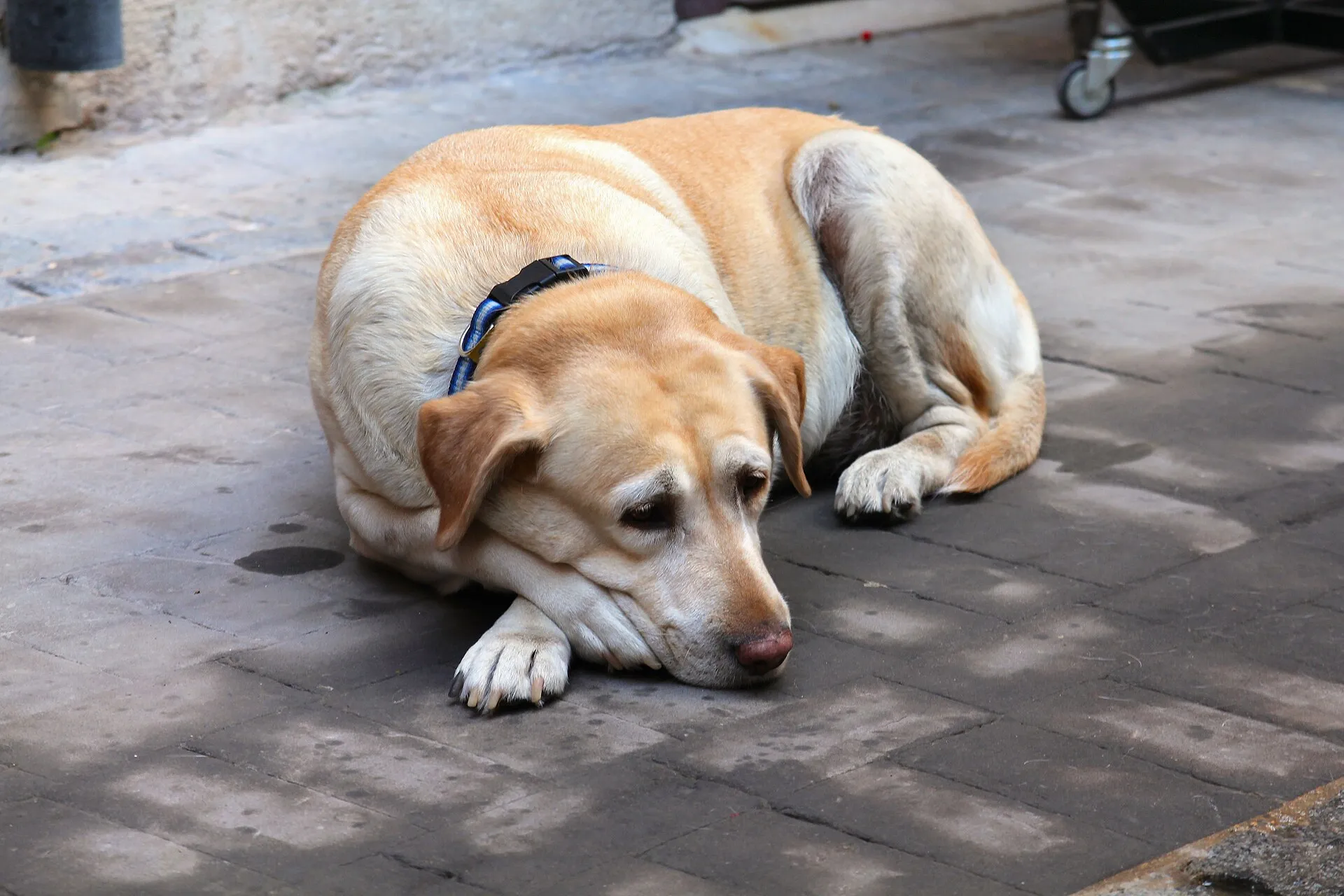
Hero image: “43 Old dog — senior labrador dog with collar resting on sidewalk” by Marek Ślusarczyk, used under CC BY 3.0.

If you’d like a starting point for what to track, the quality of life module in Ralph - Pet Wellbeing Hub gives you a standardized framework on how your dog is doing. If you’d rather a notebook, the notebook is a perfectly good answer. Either way, the data belongs to you, and your vet will know what to do with it. Get in touch if you want help thinking through what to watch for your specific dog.